
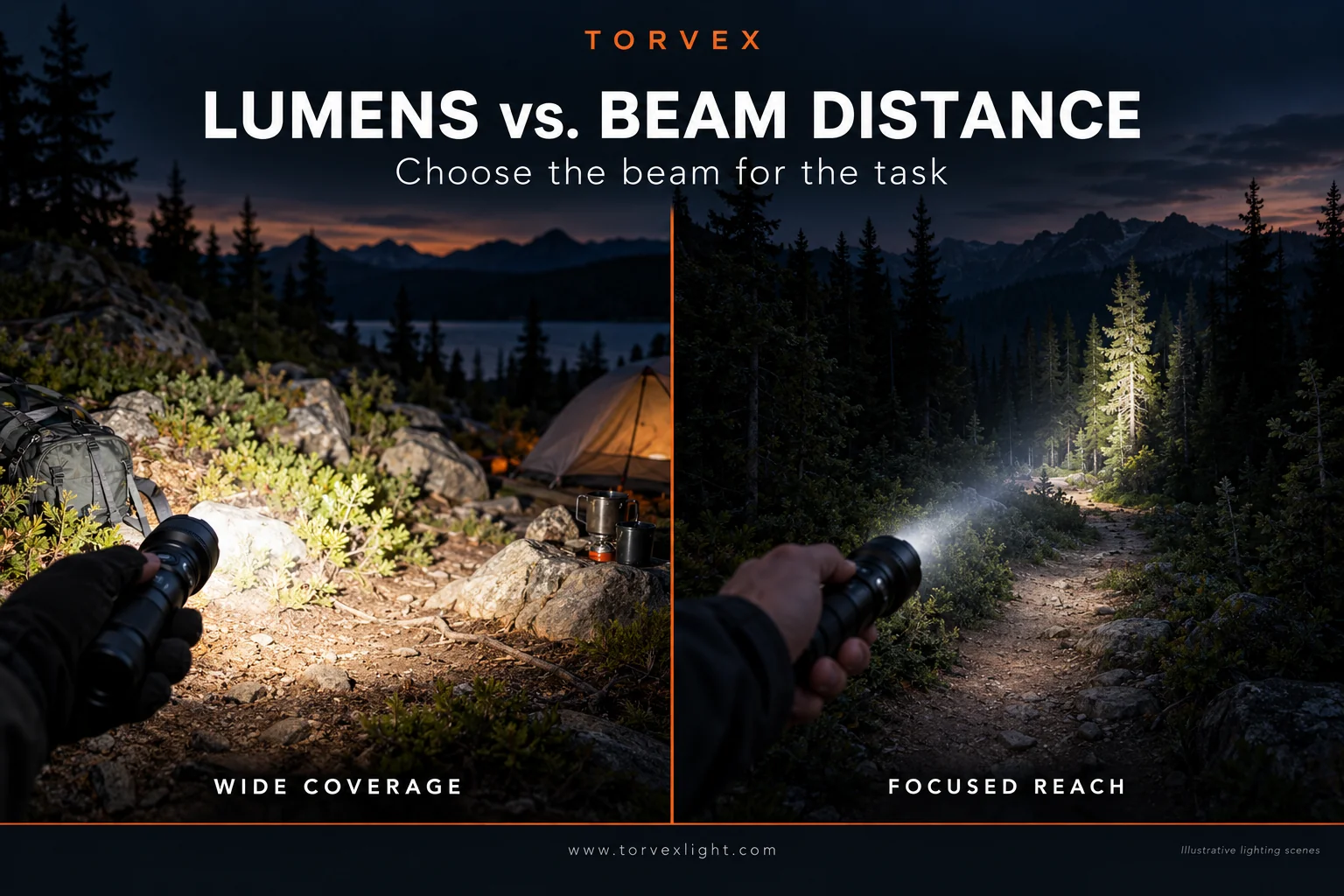
Not necessarily. A flashlight can produce a large amount of light and spread it across a wide area. Another can produce less total light but concentrate it into a narrower beam with greater reach.
For distributors, importers and private-label buyers, understanding this distinction helps when comparing quotations, evaluating samples and preparing accurate product descriptions.
1. Understand the Three Main Measurements
Lumens, candela and beam distance describe different aspects of flashlight performance.
| Measurement | What it describes | What it helps buyers assess |
|---|---|---|
| Lumens (lm) | Total visible light output | How much light the flashlight emits |
| Candela (cd) | Luminous intensity in a particular direction; flashlight specifications often report peak beam intensity | How strongly the beam is concentrated |
| Beam distance (m) | Distance at which the beam reaches a defined illuminance threshold | Rated reach under the stated test method |
These measurements work together. None provides a complete picture on its own.
A lumen rating does not tell you how wide the beam is. A beam-distance rating does not tell you how much of the surrounding area will be illuminated.
2. Why More Lumens Do Not Always Mean Greater Reach
A flashlight’s optical system—including its reflector or lens—shapes where the light goes.
A broad beam distributes light across a larger area. This can be useful for nearby tasks, but it may provide less intensity in the center.
A narrower beam concentrates more light in a particular direction. This can increase reach while illuminating a smaller area.
For example, a lower-lumen flashlight with a tightly concentrated beam can reach farther than a higher-lumen flashlight designed for wide coverage.
The purchasing question should therefore be:
Does the beam suit the customer’s task?
3. Rated Beam Distance Is Not a Guaranteed Working Distance
When beam distance is reported using the ANSI/PLATO FL 1 method, it refers to the distance at which illuminance reaches 0.25 lux.
This provides a common reference for comparing rated reach. It does not guarantee that a user can comfortably identify small details at that distance.
Practical visibility also depends on the target’s size, reflectivity and contrast, as well as ambient light and weather conditions.
For purchasing decisions, distinguish between:
- Rated beam distance: a specification tied to a defined measurement method.
- Required working distance: the distance at which the customer needs to perform a specific task.
A customer who needs to inspect an object at a certain distance should evaluate a sample under representative conditions, rather than rely only on the advertised reach.
4. Match the Beam Pattern to the Application
Most flashlight selections involve a balance between nearby coverage and distance visibility.
| Lighting need | Beam characteristics to consider | Sample evaluation focus |
|---|---|---|
| Close-up repairs or equipment checks | Broad, even illumination | Glare, shadows and visibility across the task area |
| General outdoor use | Useful central beam with surrounding spill | Visibility both ahead and nearby |
| Viewing distant objects | Concentrated central intensity | Target visibility at the required distance |
| Switching between nearby and distant tasks | Adjustable focus or separate lighting options | Ease of adjustment and performance in each setting |
“Spill” is the light surrounding the central hotspot. It can help users see nearby surroundings while the center of the beam illuminates farther ahead.
For adjustable-focus models, evaluate both the wide and narrow settings. Do not assume maximum coverage and maximum reach are available at the same time.
5. Keep Performance Claims Connected to Their Modes
A specification sheet may list maximum lumens, longest runtime and maximum beam distance prominently. These figures may come from different operating settings.
Before comparing products, ask suppliers:
- Which mode produces the stated lumen output?
- Which mode or focus position produces the stated beam distance?
- What battery was used for testing?
- Does output decrease as the light warms up or the battery discharges?
- Is the runtime figure associated with the same setting?
A product description should not imply that maximum brightness continues for the longest advertised runtime unless the supporting data confirms it.
Where available, an output-over-time graph provides more useful information than a single runtime number.
6. Compare Samples Under Consistent Conditions
A practical side-by-side check can reveal differences that are difficult to understand from specification sheets.
Use a repeatable process:
- Charge each sample fully or install the specified fresh batteries.
- Select and record the operating mode.
- Position the lights at the same distance from the same target.
- Compare hotspot size, surrounding spill and beam uniformity.
- Repeat the check at the customer’s intended working distance.
- Observe how the output changes during operation.
- Record battery details, elapsed time and environmental conditions.
If taking comparison photographs, keep exposure and white balance fixed. Automatic camera adjustments can make different outputs appear similar—or exaggerate their differences.
Visual checks help assess suitability, but they do not replace calibrated measurements when confirming numerical performance claims.
7. Ask for Comparable Data Before Approving Product Content
Before using specifications on packaging or product pages, confirm the source and basis of each figure.
A useful supplier checklist includes:
- Finished-product light output, rather than an LED component’s theoretical output.
- Peak beam intensity, if available.
- Beam distance and the measurement method used.
- Operating mode and focus position.
- Battery specification and test conditions.
- Runtime information for the relevant settings.
Keep unverified values separate from approved specifications. Do not calculate beam distance from lumens alone: the optical distribution is also required to understand reach.
Clear, consistent data makes it easier for sales teams and distributors to explain why one model suits a task better than another.
Choose for the Task, Then Compare the Numbers
A useful flashlight range can include models for broad coverage, everyday mixed use and greater reach. Each serves a different requirement.
Start with the application, evaluate the beam pattern, and then compare brightness, distance and runtime under clearly stated conditions.
Explore Flashlights for Your Product Range
TORVEX welcomes enquiries from distributors, importers and private-label buyers selecting portable lighting products.
Tell us what your customers need to illuminate, at what distance, and for how long. These details provide a practical starting point for discussing models and sample requirements.