
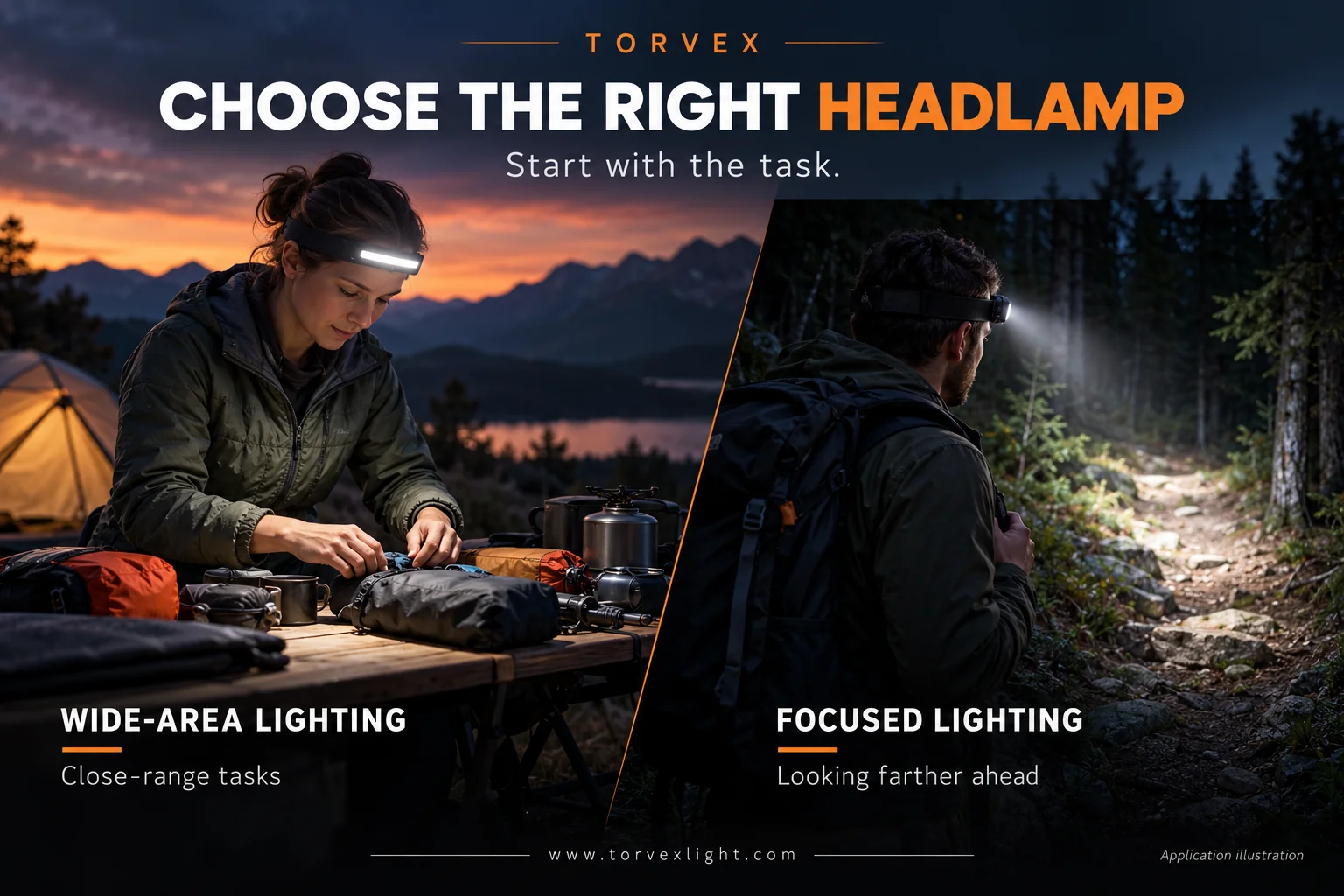
For distributors and private-label buyers, these differences help define a useful product range. Brightness matters, but beam pattern, wearing comfort and everyday operation also deserve attention.
This guide explains how to compare wide-area and focused lighting—and what to check before approving a sample.
1. Start with the Lighting Task
Before comparing models, identify where customers will use the headlamp and what they need to see.
| Typical task | Lighting direction to consider | What to check on a sample |
|---|---|---|
| Close-up repairs and assembly | Wide, even illumination | Visibility across the working area and glare from reflective surfaces |
| Setting up a tent or organizing equipment | Wide-area lighting | Useful low setting and visibility around the hands |
| Looking farther along a path | Focused beam or combined beam | Reach, central hotspot and visibility near the feet |
| General use across several tasks | Selectable wide and focused lighting | Ease of switching and runtime in each mode |
Use this table as a starting point. The final choice should follow a practical sample evaluation under the intended conditions.
2. Wide-Area Lighting for Close-Range Tasks
A wide beam spreads light across a broader area. This is useful when users need to see several nearby objects without repeatedly turning their head.
COB strip headlamps are one format to consider for this purpose. Their broad illuminated surface can suit tasks such as organizing equipment, handling tools or working around a campsite.
However, COB describes an LED packaging approach; it does not guarantee a particular beam angle, uniformity or brightness. Judge the actual light pattern produced by the complete product.
When reviewing a wide-area headlamp, check:
- Whether the task area is illuminated evenly.
- Whether the lowest setting is comfortable for close work.
- Whether light reflects uncomfortably from nearby shiny surfaces.
- Whether the lamp stays in position while the user moves.
3. Focused Lighting for Greater Reach
A focused beam concentrates more light into a narrower direction. It can help users identify objects farther away or inspect a particular point.
The tradeoff is coverage. A bright central spot may be useful at a distance while providing less light across the nearby working area.
For a focused-beam sample, examine the central hotspot and the surrounding light. Check whether the transition is comfortable and whether the beam suits the intended viewing distance.
If the product offers adjustable focus, test both ends of the adjustment range. Also check how securely the mechanism holds its position.
4. Consider Combined Lighting for Mixed Tasks
Some headlamps provide separate wide-area and focused light sources. This gives users a choice when their tasks change.
Before selecting a combined model, confirm:
- Can each light source operate independently?
- Can both operate together?
- How do users switch between them?
- What is the runtime for each available setting?
Do not assume that a combined mode provides the same runtime as either light source operating alone. Request mode-specific information.
5. Compare More Than Maximum Lumens
Lumens describe total light output. They do not describe how that light is distributed.
Two headlamps with similar lumen ratings can produce noticeably different results: one may illuminate a broad nearby area, while another directs more light toward a distant point.
Ask suppliers to identify which mode each brightness and beam-distance claim refers to. When testing samples, compare products at the same distance and under the same conditions.
For product listings, keep brightness, beam distance and runtime clearly associated with their respective settings.
6. Check Runtime, Charging and Wearing Comfort
A single runtime figure is not enough to compare products fairly. Ask which mode was tested, what battery was used and how the end of the test was defined.
Also confirm whether brightness decreases during operation. A lamp remaining on does not necessarily mean it maintains its initial output throughout that period.
For rechargeable models, verify the charging connector, input requirements, charging time and battery indicators. Test the charging arrangement supplied or recommended for the product.
Comfort should be evaluated with the battery installed. Wear the sample while looking down, turning the head and moving around. Check headband adjustment, pressure points, balance and tilt retention.
A short handling check may miss issues that become apparent during a longer working session.
7. Test Controls in Real Use
Extra functions are useful only when users can operate them reliably.
Check whether the main switch is easy to identify and press. If the target application involves gloves, test it with the gloves customers are likely to wear.
For models with gesture control, evaluate activation and unwanted triggering during normal movement. Confirm whether the sensor can be disabled.
Also check mode order, direct-off behavior and protection against accidental activation during storage.
8. Build a Range Around Distinct Needs
For an initial headlamp assortment, consider three clear roles:
- Wide-area model: for nearby tasks and general campsite use.
- Focused-beam model: for users who prioritize reach.
- Combined model: for customers who need both lighting patterns.
Each model should have a clear reason to be included. Compare samples against the same checklist, and use confirmed specifications consistently across packaging, product pages and sales materials.
Find the Right Headlamps for Your Range
TORVEX welcomes enquiries from distributors, importers and private-label buyers comparing headlamp options.
Share your target application, preferred lighting pattern and purchasing requirements so we can discuss relevant models and sample specifications.