
How long will a rechargeable searchlight run, and how long does it take to recharge?
These are straightforward questions, but useful answers need more than two numbers. Buyers should know which lighting mode was tested, how the output changes during use and what charging conditions apply.
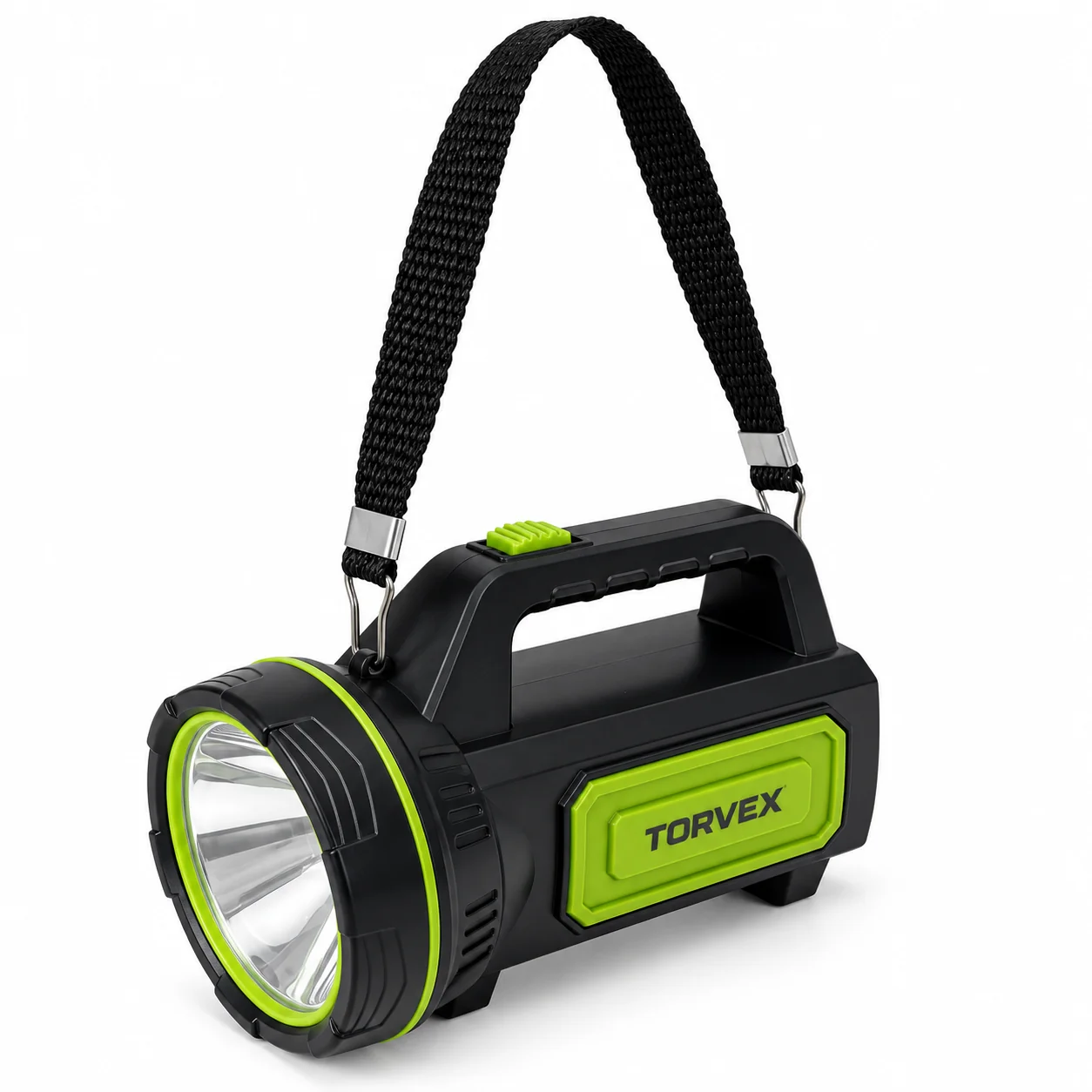
The TORVEX FL-882 provides a practical starting point for this discussion. It combines a main light and a side light in a compact design with a carry handle and USB Type-C charging.
For distributors and private-label buyers, evaluating these functions separately helps turn a basic specification sheet into a clearer product offering.
1. Start with the Product and Its Intended Tasks
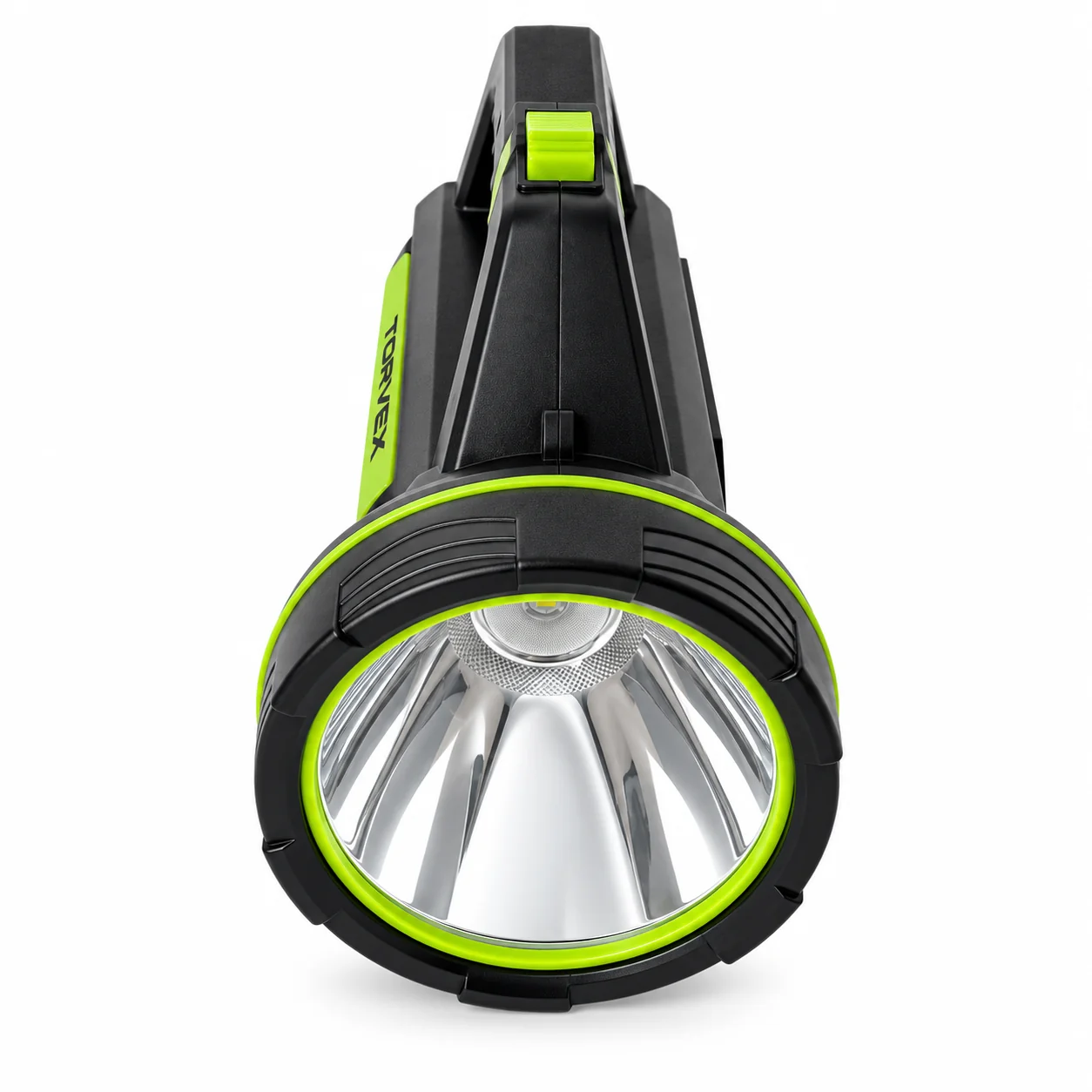
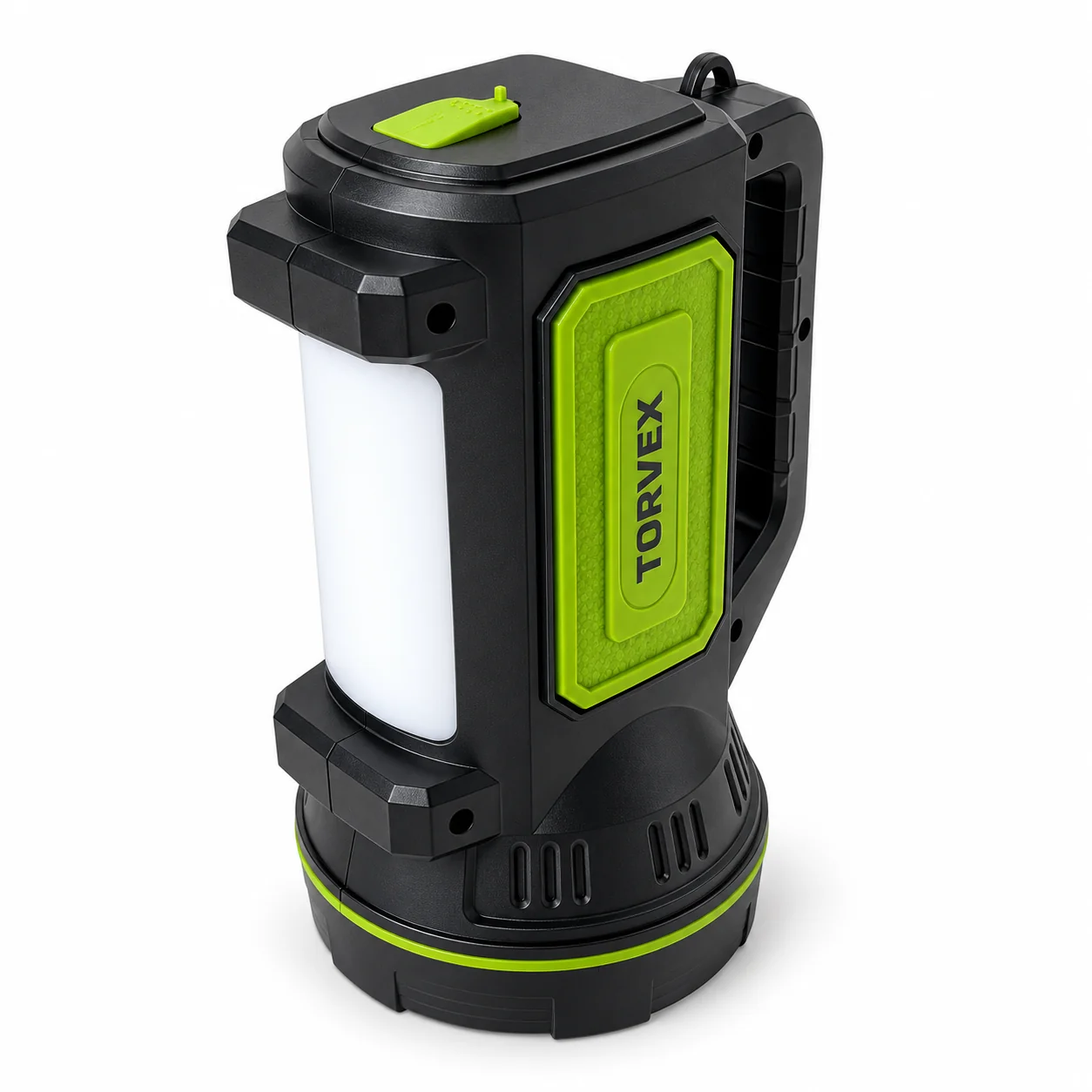
The FL-882 offers two lighting options in one unit:
- Main light: a forward-facing light source.
- Side light: an additional light source on the side of the housing.
The carry handle provides a convenient way to transport the light. Its usefulness for a particular task should be checked with a sample, including how the light is held or positioned.
The supplied product information includes:
| Item | FL-882 specification |
|---|---|
| Light source | High-power LED |
| Lighting modes | Main Light / Side Light |
| Charging connector | USB Type-C |
| Battery capacity | 1,200 mAh |
| Stated full charging time | Approximately 4–5 hours |
| Switch | Push button |
| Housing material | ABS |
| Dimensions | 150 × 85 × 57 mm |
These specifications describe the product’s basic configuration. Mode-specific runtime information needs to be considered separately.
2. Connect Every Runtime Figure to a Lighting Mode
The supplied FL-882 information lists a runtime of six hours, but does not identify whether this applies to the main light or side light, or state the test endpoint.
That figure should therefore be treated as information requiring clarification before it is used as a mode-specific claim.
It should not be presented as six hours of operation for both lighting options.
Before approving packaging or a product listing, ask:
- Which light source was operating?
- Was the battery fully charged at the start?
- Did the light maintain its initial output?
- What condition marked the end of the test?
- What were the ambient conditions?
A useful runtime record connects the operating mode, battery condition and test method to the result.
3. Check How the Light Performs During Operation
A light remaining switched on does not necessarily mean it maintains the same brightness throughout its runtime.
For sample evaluation, observe the FL-882 at intervals while it operates in the selected mode. Record whether the output changes gradually, changes noticeably at a particular point or remains reasonably consistent during the period relevant to the customer’s task.
If brightness measurements are needed, use suitable equipment and a repeatable method. A visual check can help assess practical usability, but it cannot establish a verified lumen figure.
For product descriptions, keep these questions separate:
- How long does the light remain on?
- How long does it provide sufficient illumination for the intended task?
The second question depends on what the customer needs to see.
4. Evaluate the Main Light and Side Light Separately
Do not assume that the two light sources use the same power or provide the same runtime.
Test each mode from a comparable starting condition, with the battery fully charged before each test.
| Check | Main light | Side light |
|---|---|---|
| Intended task | Define the forward-facing lighting requirement | Define the task and positioning requirement |
| Light distribution | Observe the central beam and surrounding coverage | Observe coverage across the nearby surface |
| Runtime | Record the result for this mode | Record the result for this mode |
| Output changes | Note changes during operation | Note changes during operation |
| Positioning | Check carrying and aiming comfort | Check whether the light can be positioned usefully |
This approach also helps buyers decide whether both lighting options add value for their customers.
5. Confirm What the Charging Time Refers To
The stated full charging time for the FL-882 is approximately four to five hours.
When checking this figure, record the battery’s starting condition, the power source, the cable and how full charge is identified.
USB Type-C describes the connector. It does not, by itself, confirm fast charging, the required input rating or compatibility with every charging arrangement.
Before approving the supplied configuration, confirm:
- The rated charging input.
- The recommended power source and cable.
- Which charging accessories are included.
- How charging and full-charge status are indicated.
- Whether operation while charging is permitted.
Do not assume the product supports use while charging unless the operating instructions confirm it.
6. Do Not Use Battery Capacity Alone to Predict Runtime
The FL-882’s stated battery capacity is 1,200 mAh. This is useful product information, but it is not a complete runtime specification.
Runtime also depends on battery voltage, usable energy, the power required by the selected light source and the way the product controls its output.
Two rechargeable lights with the same stated capacity may perform differently.
For a fair comparison, evaluate products in modes that suit the same task. Compare useful illumination and operating time together, rather than ranking products by battery capacity alone.
7. Keep a Simple Sample Evaluation Record
A consistent record makes discussions with suppliers and customers more precise.
For each FL-882 sample, record:
- Sample identification and supplied accessories.
- Charging source, cable and charging duration.
- The indication used to identify full charge.
- The selected lighting mode.
- Output observations at recorded intervals.
- Total operating time and the test endpoint.
- Any issues with the switch, handle or charging connection.
Repeat the relevant checks for the other lighting mode. Keep the conditions as consistent as practical and document any differences.
These records help identify which claims are ready for publication and which still need supporting information.
8. Turn Confirmed Results into Clear Sales Information
Once the test conditions and results are confirmed, present them in language customers can understand.
List runtime separately for the main light and side light where the results differ. Describe charging time as approximate when appropriate, and specify the required charging arrangement in the instructions.
Avoid combining the longest runtime with a photograph or headline that implies it applies to another mode.
Clear specifications help distributors explain the product accurately and give end users more realistic expectations.
Explore the TORVEX FL-882
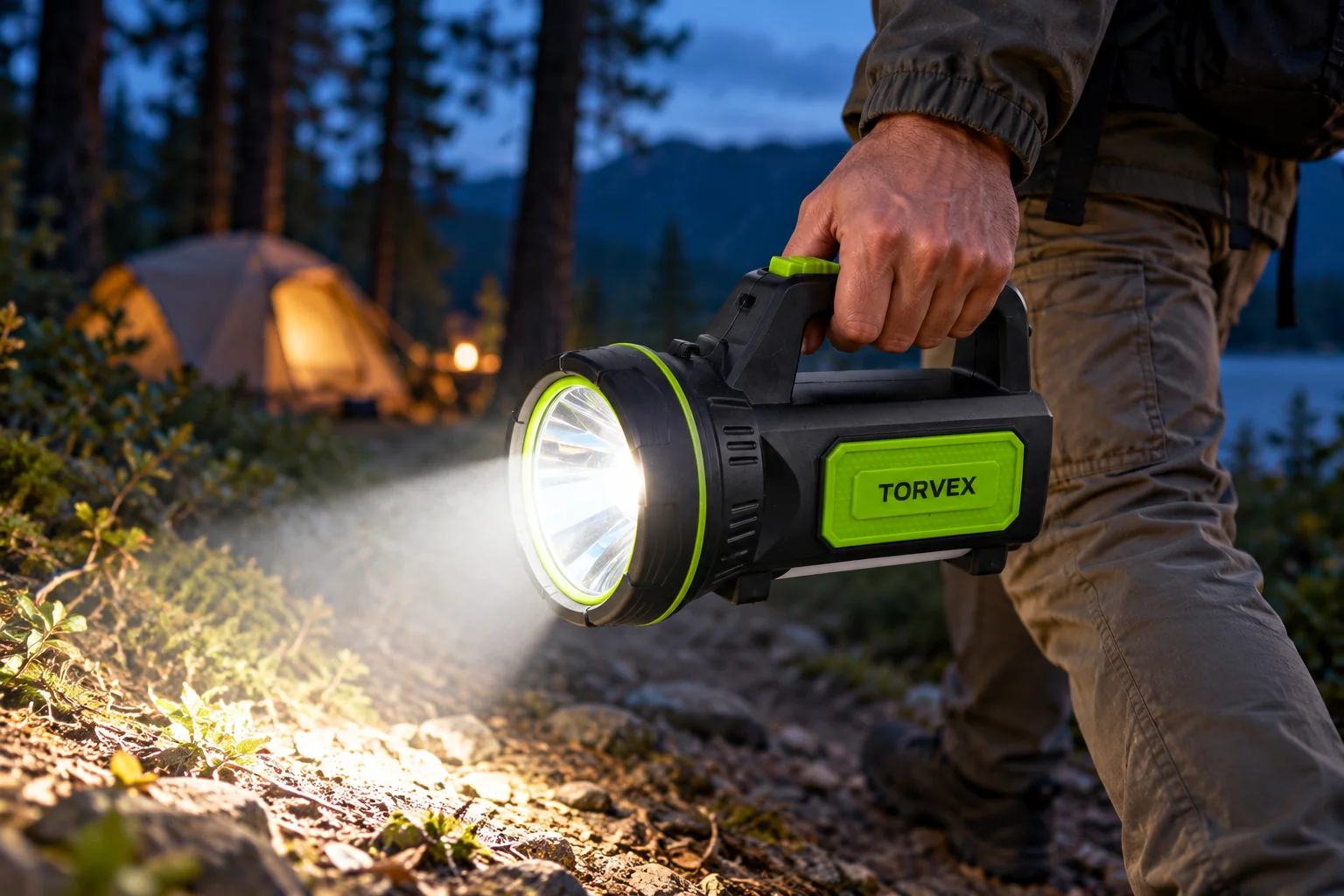
The FL-882 combines main and side lighting, USB Type-C charging and a carry handle in a compact ABS housing.
For distributors and private-label buyers considering this model, the next step is to confirm the supplied configuration and evaluate both lighting modes against the intended application.
Contact TORVEX for FL-882 specifications, sample enquiries and quotations.
View FL-882 Rechargeable LED Searchlight